
Hello, I am Raj Kumar Sharma
Born in Rohtak, Haryana, at a time when it was a small, quiet town. I have been a sportsman, a student of philosophy, a cinema hall owner, a businessman, a husband, a father, a grandfather — and finally, at the age of seventy, an author.
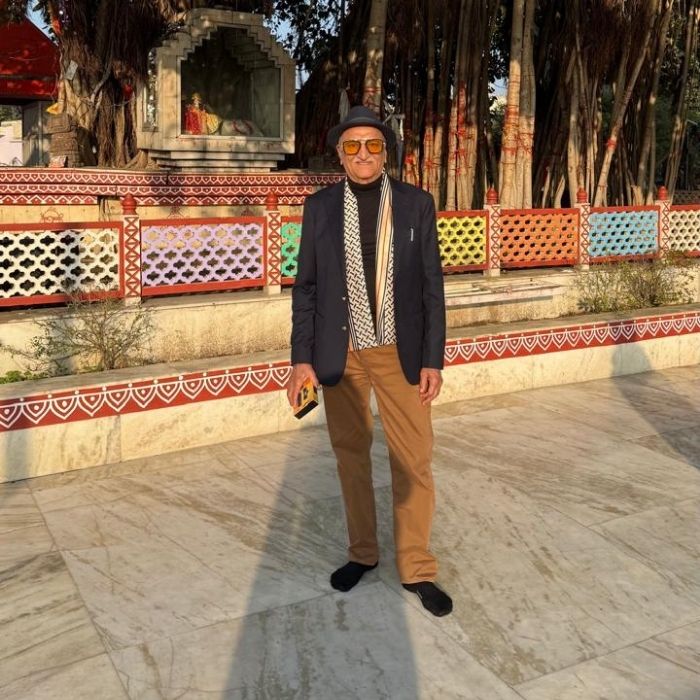
Growing Up in Rohtak — A Joyful, Simple Life
I was born in Rohtak, Haryana, at a time when it was a small, quiet town. We were a large joint family. My grandfather was a Captain, a commanding man who held everyone together. My father was a graduate and the Manager of a cinema hall, which in those days was a position of great dignity and social respect.
Ours was a middle-class home with modest means but genuine warmth. Our pleasures were simple: walks in the park, Ram Leela, Dussehra Mela, weddings with our best clothes on. I was, by my own honest admission, a mediocre student. My father dreamed of making me a doctor. Science never agreed with me. What changed me was a quiet decision to start exercising, and within months I was physically strong, confident, and transformed. That was my first real lesson: with discipline and hard work, you can become whoever you decide to be.
The Sportsman – From Laughed At to College Captain
When I joined college, I chose Arts and discovered sport. One rainy 15th August, I walked into the college common room where a group was playing table tennis. Some were students, some outsiders. I asked to join. They refused, saying I did not know how to play. When they finally gave me a racket, they were right. I could not keep the ball on the table. I could not control the board. They laughed.
That day I made a silent decision. I bought two ordinary rackets and began practising alone, every single day. I sought out every player I could find. I trained, I lost, I trained again. After two years of relentless work I beat everyone in college and every outsider. I became Captain of my college table tennis team. I also played lawn tennis at a competitive level.
But the racket never left my hand — not truly. Decades passed, life threw its own tournaments at me: business, family, loss, reinvention. Through all of it, the discipline of sport remained in my bones. And then, in 2017, long after most men had set aside any thought of competition, I stepped onto the table once more — this time at the South Asian level. I won the Bronze Medal. Not as a young man hungry to prove himself, but as someone who had lived enough to know what winning truly costs.
I was a mediocre student in my books, but on the sports ground — and later, in the arena of life itself — I had become someone. That taught me: a man is not defined only by his marks, nor only by the medals on his wall. He is defined by his character and his courage to keep trying, year after year, decade after decade, until the very end.
Achievement
Bronze Medal — South Asia Veterans Table Tennis Championship, 2017. A medal earned not in youth, but after a lifetime of character built far away from the table.
“They laughed when I could not hold the racket. Years later, I stood on a podium at South Asia. I did not think of them. I thought of every morning I had practised alone.”
The Philosopher’s Student – The Mentor Who Shaped My Values
My Master’s degree in Political Science brought me to a man I will never forget: Dr. Madan Gopal Gandhi. He was a bachelor, a gold medalist in both English and Political Science from Punjab University, Chandigarh, and a scholar who had written books across many subjects. He had deep knowledge of astrology, philosophy, and the arts. He painted on canvas and then wrote poems inspired by those very paintings. Sometimes he wrote the poem first and then painted it. I had never seen a mind work like that. From Dr. Gandhi I learned the values I still carry: honesty, truthfulness, morality, ethics, a respect for traditions, and the true meaning of human relationships. I was proud at that time to believe I had all these qualities. It was only later, much later, that I discovered how difficult it is to hold onto such values in a world that measures a man’s worth purely by his wealth.
The Businessman – The Cinema Hall: Rise and Reinvention
While I was still studying, my father made the bold decision to build a cinema hall of his own. He had spent years managing one and knew the business deeply. The world of cinema had always been close to our family — and perhaps that closeness had seeped into me more than I realised. In those college years, when I was young, well-built and confident from sport, I was offered a lead role in a Haryanvi film. I accepted. To see oneself on screen, to speak lines and inhabit a character before a camera — it was exhilarating, a glimpse of a world that dazzled. The film exists to this day, a quiet reminder of the young man I once was.
By the time I finished my degree, the cinema hall was ready and my father handed all operations to me. I was thrilled — but I had no real knowledge of running a business, and that gap would cost us greatly.
There was a common practice of selling tickets at a premium for new film releases. I refused. My values told me it was wrong, and I lost what could have been significant income. The losses came. Film after film failed. The bank interest mounted. My father, who had put his entire life savings into this dream, was losing his health. People taunted us. Every employee left because I could not pay them. I fell into a deep and chronic depression.
One man stayed. He was not highly educated but he was wise. He came to me and said: “Babuji, do not lose heart. In today’s world, honesty alone is not enough. You must also be clever.” That day broke something in me and built something new. I worked eighteen hours a day. I adopted the practical ways of the world without abandoning my core values entirely. I became the most successful businessman in the cinema trade in the city. I married a wonderful woman, the daughter of a prominent industrialist, and was blessed with three children.
On screen
Raj Kumar Sharma in his lead role in a Haryanvi film — watch the film here on YouTube.
“I had once stood before a camera as an actor. Later I stood behind a counter as a businessman. The cinema taught me many things but the hardest lessons came not from the screen, but from the ledger.”
The Author – A Fountain Pen, a Mother’s Visit and a Granddaughter’s Words
Then COVID came. The city locked down. Streets went silent. I, who had always been active, meeting friends daily, playing sport, moving freely through social life, found myself confined to four walls for the first time in my life. After a week, something stirred inside me. I remembered that as a young man I used to write late at night: reflections on the disparities of society, on wealth and poverty, on caste and class. I had forgotten I could write.
I picked up my beloved fountain pen, filled it with ink, and sat down to begin. But a thought stopped me. There were true incidents in my life I was not sure the world was ready to hear. I considered hiding them. Then another thought came: if I hide the truth, I am being dishonest. And I have tried my entire life not to be dishonest.
I could not sleep that night. It was 3 AM. And then I felt a presence beside me. I looked. It was my mother. She had been gone for many years, but she was there, sitting with me just as she always used to. She was laughing. “Why are you disturbed?” she asked. I told her I wanted to write but did not know how to begin. She said: “Since your childhood, you have always done what you desired. Start writing. I am with you.” And then she was gone.
The very next morning I began, and the words came on their own. Stories, memories and reflections arrived without me searching for them. One morning, my nine-year-old granddaughter looked at me working and said to her younger brother: “Don’t you know? Dadaji is an author.”
That was the moment I knew.